
Project 2
Goddess Girls: Athena the Brain and Modern Reception
Learning Goal: Develop multi- and cross-cultural perspectives and apply them to gender, ethnic, and social issues
Literacy: Technology
Despite having a progressive concept, Athena the Brain does not always present Athena breaking stereotypical gender roles, and throughout the story, Athena and the other female characters fluctuate between being counter-stereotypes and stereotype-conforming. This can have lasting consequences for young girls and their beliefs about gender roles in society. However, in using Greek myths, the authors, Joan Holub and Suzanne Williams present familiar characters with new and relatable goals and personalities, while also adding a layer of knowledge that draws upon these myths.
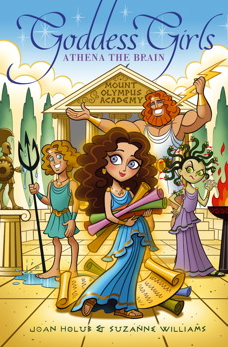
"Throughout other moments in the story, Athena has stood up for herself even at some of her lowest moments, especially regarding Medusa, another female character in the story. But when she is against Poseidon, a male character she does not regard highly, she buckles underneath the weight of her lack of confidence."
For this paper, we were assigned to take a deeper look into how mythology appears in classical reception. I decided to write my paper on the first book of the Goddess Girls series, Athena the Brain. Overall, this paper was not the most successful. I found this paper particularly difficult because I’m not very familiar with classical reception pieces. Additionally, it was difficult to find literature that I could use to form and bolster my arguments. These things together made the assignment a larger burden than I had originally thought it would be. Regardless, this paper did force me to consider classical reception as a concrete concept rather than the more nebulous definition of it that I had had before. I now know that classical reception is not something that I’m particularly interested in, but I staunchly believe that I am a more well-rounded Classics major because of writing this paper.
Without having had this opportunity, I would be at a loss when discussing Classics with a larger audience. Many people are not familiar with the material I learn in class, but many people have watched or read pieces of classical reception, and this allows me to become a bit closer to them.
If I could redo this item, I would change the topic completely. I chose Athena the Brain because of my familiarity with it, but if I could redo this assignment, I would choose a work that is a bit older with more literature about it. Not only would this have (presumably) made the assignment a bit easier, but it would have also introduced me to media that I have not had the chance to discover.